New Sales: (450) 234-8957
Pre-Owned Sales: (450) 234-0008
Service: (833) 960-1710
Parts: (450) 661-1555

New Sales: (450) 234-8957
Pre-Owned Sales: (450) 234-0008
Service: (833) 960-1710
Parts: (450) 661-1555
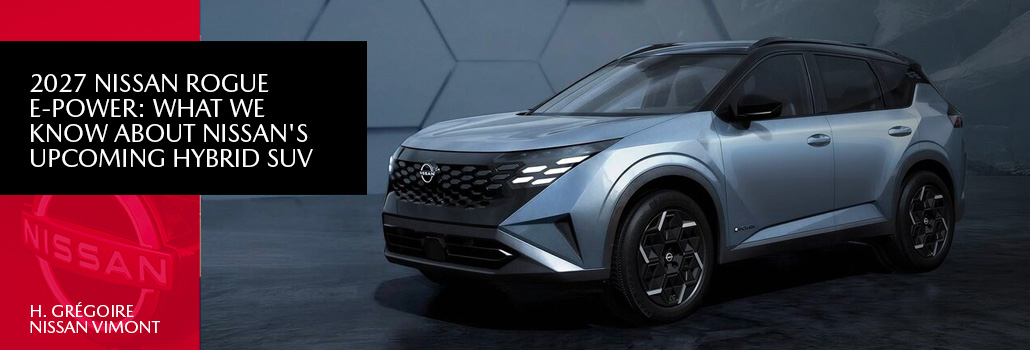
The 2027 Nissan Rogue e-POWER is shaping up to be one of the most significant evolutions of Nissan’s popular compact SUV in years. For motorists in Laval and the Greater Montreal area looking for a versatile family vehicle while reducing fuel consumption, this new generation is already worthy of attention.
The big news will obviously be Nissan’s e-POWER technology. Unlike a conventional hybrid vehicle, the Rogue e-POWER adopts an architecture where propulsion is provided by electric motors. The gasoline engine primarily acts as a generator to produce the electricity required by the system. Drivers thus enjoy several features associated with electric driving without having to plug in their vehicle.
However, the 2027 Nissan Rogue e-POWER is not yet available at dealerships as of this writing, and several Canadian specifications remain to be confirmed. Information regarding final horsepower, trim levels, standard equipment, official fuel economy ratings, towing capacity, and pricing may evolve prior to launch.
You don’t have to wait for the 2027 model to experience the Rogue, though. At HGrégoire Nissan Vimont Laval, you can discover the Nissan Rogue, check out our new Nissan Rogue inventory, and compare currently available options today.
The term e-POWER can cause confusion since it refers neither to a 100% electric vehicle nor to a traditional plug-in hybrid. Nissan’s technology stands out for how the internal combustion engine and electric motors work together.
In the 2027 Nissan Rogue e-POWER, electric motors drive the wheels. The 1.5-liter gasoline engine serves mainly to generate the electricity the vehicle needs. A lithium-ion battery of about 2 kWh temporarily stores this energy as well as power recovered during deceleration.
This architecture significantly changes the behind-the-wheel experience. In a traditional gas-powered vehicle, the combustion engine is mechanically linked to propulsion via a transmission. With e-POWER, the driver benefits instead from the immediate throttle response of electric motors.
Nissan also plans for two electric motors, allowing the Rogue e-POWER to offer all-wheel drive—a feature particularly attractive for the Canadian market. The system can manage power distribution between axles to optimize traction and stability depending on road conditions.
For a Laval driver who has to deal with snow, ice, rain, and rapidly changing road conditions, this setup could become one of the most compelling arguments for the new Rogue.
One of the most interesting features of the e-POWER system is that it requires no plug-in charging. You fill up with gas just like with a traditional vehicle, and the car manages electricity generation, recovery, and usage on its own.
This distinction is key when comparing the future Rogue e-POWER to the 2026 Nissan Rogue Plug-in Hybrid.
The 2026 Rogue Plug-in Hybrid features a much larger 20 kWh battery and can travel up to 61 km in electric mode under ideal conditions. It is therefore particularly appealing to drivers who can charge regularly at home or at work.
The Rogue e-POWER targets a different use case. It aims to deliver the smoothness, responsiveness, and partial efficiency of an electric powertrain while retaining the simplicity of refueling with gas.
Imagine a daily commute between Vimont and downtown Montreal. In urban traffic and heavy congestion, the system can take full advantage of electric propulsion and energy recovery. When merging onto Highway 15, Highway 440, or taking a longer trip to the Laurentians, the gas engine can run more to produce the required electricity.
There is no need to choose between a depleted battery and an available charging station. A quick stop at the gas station is all it takes.

Full Canadian specifications for the 2027 Rogue e-POWER have not yet been disclosed. It is therefore important not to assign power or torque figures that are not official yet.
What we do know offers insight into the vehicle’s philosophy. The next-generation e-POWER system uses a 1.5-liter gasoline engine as a generator, a small lithium-ion battery, and dual electric motors to provide propulsion and all-wheel drive.
The concept of a “transmission” also takes a different form. Because the electric motors drive the wheels, the Rogue e-POWER does not require a conventional transmission comparable to the Xtronic CVT found in the gas-powered 2026 Rogue.
This should contribute to smoother, more linear acceleration and an immediate response feel. An electric motor delivers torque very differently from a combustion engine, allowing for quick response as soon as you step on the accelerator.
This characteristic can be particularly enjoyable during daily commutes in Laval, whether merging onto Highway 440, driving down Boulevard des Laurentides, or picking up speed on Highway 15.
Fuel economy will obviously be one of the top questions surrounding the 2027 Nissan Rogue e-POWER Hybrid. Official Canadian ratings will be confirmed closer to launch.
Nissan is aiming for a major efficiency improvement over the current gas-powered Rogue. Early indications suggest fuel consumption could hover around 6 L/100 km, though this figure should currently be viewed as an estimate rather than an official Natural Resources Canada rating.
For reference, the gas-powered 2026 Nissan Rogue comes equipped with a 1.5-liter VC-Turbo engine producing 201 horsepower and 225 lb-ft of torque. With all-wheel drive, its official ratings reach approximately 8.3 L/100 km city and 6.8 L/100 km highway, or 7.6 L/100 km combined depending on the trim level.
The potential advantage of e-POWER should be especially noticeable in city driving. Deceleration and braking allow the system to recover energy that would otherwise be lost as heat through friction brakes.
For drivers commuting frequently between Laval, Montreal, Terrebonne, Blainville, Boisbriand, Sainte-Thérèse, and other North Shore communities, this efficiency could add up to noticeable savings over a full year.
| Feature | 2027 Nissan Rogue e-POWER | 2026 Nissan Rogue | 2026 Nissan Rogue Plug-in Hybrid |
| Powertrain Type | e-POWER Hybrid | Turbocharged Gasoline | Plug-in Hybrid |
| Gas Engine | 1.5 L, primarily used as generator | 1.5 L 3-cylinder VC-Turbo | 2.4 L 4-cylinder |
| Horsepower | TBD | 201 hp | 248 hp combined |
| Torque | TBD | 225 lb-ft | 332 lb-ft combined |
| Propulsion | Dual electric motors | Gasoline engine | Electric motors and gas engine |
| All-Wheel Drive | Planned | Intelligent AWD available/standard depending on trim | Intelligent AWD |
| Conventional Transmission | No | Xtronic CVT | Hybrid system |
| Battery | Approx. 2 kWh | No traction battery | 20 kWh |
| Plug-in Charging | No | No | Yes |
| All-Electric Range | N/A like a PHEV | None | Up to 61 km |
| Fuel Economy | TBD, targeting around 6 L/100 km | Approx. 7.6 L/100 km combined depending on trim | Up to 3.7 Le/100 km announced |
| Seating Capacity | 5 expected | 5 | Up to 7 |
| Maximum Cargo Volume | TBD | Up to 2,098 L | Up to approx. 1,832 L |
| Towing Capacity | TBD | Up to 680 kg (1,500 lb) | Up to 680 kg (1,500 lb) |
| Target Experience | Electric driving without charging | Traditional versatility | Rechargeable electric driving + gas |
This table highlights how the three models cater to different needs. Data for the 2027 Rogue remains preliminary until official Canadian specifications are released.

The e-POWER system isn’t just about how energy is produced; it also transforms how the vehicle is driven.
The 2027 Rogue is expected to feature e-Pedal technology, allowing drivers to rely primarily on the accelerator pedal to manage both acceleration and deceleration. When lifting off the pedal, the electric motors recover kinetic energy to recharge the battery.
This regenerative braking is particularly effective in urban settings. On routes with frequent traffic lights, stop-and-go conditions, and constant speed changes, the system can continuously harvest energy.
These are precisely the driving conditions that many Laval and Greater Montreal drivers navigate every day.
The generational redesign of the Rogue is also expected to bring significant updates to the cabin. Prototypes spotted so far suggest larger displays and a more advanced digital presentation.
Exact features for Canadian trim levels will be announced closer to launch to clarify standard equipment versus features reserved for higher trims.
We can reasonably expect Nissan to continue prioritizing connectivity, driver-assistance features, and convenience amenities designed for everyday usability. The current Rogue already offers a comprehensive tech environment, and a next-generation model serving as a core product for Nissan will surely push that evolution further.
For current Nissan owners, the MyNISSAN app offers a glimpse into available digital services and seamless vehicle integration with your daily life.
Final cargo capacity for the 2027 Nissan Rogue e-POWER is not yet known. Canadian specs will clarify the exact impact of the battery and electrical components on available trunk space.
However, the 2026 Rogue provides an excellent benchmark. In select configurations, it offers up to 1,033 liters behind the second row and up to 2,098 liters with the rear seats folded down.
This generous capacity helps explain why the Rogue is so popular with families. A stroller, grocery bags, sports gear, or luggage for a weekend getaway in the Laurentians easily fit into the daily routine of this compact SUV.
The new-generation e-POWER will retain a two-row, five-passenger layout. We will closely monitor its official cargo dimensions once Nissan releases the Canadian technical specification sheet.
The upcoming arrival of the Rogue e-POWER doesn’t mean you need to postpone buying a vehicle.
The 2026 Nissan Rogue remains a highly compelling choice for drivers who want a new SUV right now. Its 1.5-liter VC-Turbo engine delivers 201 horsepower and 225 lb-ft of torque, while its Intelligent All-Wheel Drive system is well-suited for Quebec driving conditions.
Its five-seat cabin, cargo capacity reaching up to 2,098 liters, and maximum towing capacity of 1,500 lb make it a versatile performer.
For drivers looking to switch to an electrified powertrain right away, the 2026 Rogue Plug-in Hybrid offers a distinct alternative. Its 20 kWh battery provides up to 61 km of announced all-electric range, paired with a powertrain delivering a combined 248 horsepower and 332 lb-ft of torque.
You can check our new Nissan Rogue and Rogue Plug-in Hybrid inventory to view models currently available at HGrégoire Nissan Vimont Laval.

Choosing an SUV in Laval means handling a wide variety of conditions within a single week. The vehicle can be used for urban commutes Monday through Friday, face a winter snowstorm, haul the family on weekends, and hit the highway toward the Laurentians.
That is where the Rogue naturally fits in.
From our dealership located at 4540 Boulevard Robert-Bourassa in Laval, we serve motorists from Vimont and Laval, as well as surrounding North Shore and Greater Montreal communities.
The future Rogue e-POWER could be uniquely tailored to this lifestyle. Its electric drive promises a quiet, responsive ride for city trips, while its gasoline engine removes the need to plan long road trips around charging stations.
The next-generation Rogue e-POWER is expected to arrive in late 2026 as a 2027 model. Exact delivery timelines to Canadian dealerships may vary. For the latest updates regarding its arrival in Laval, feel free to contact HGrégoire Nissan Vimont Laval.
No. That is one of the main differences between e-POWER and a plug-in hybrid powertrain. You simply fill up with gas, and the vehicle generates the required electricity onboard.
Not in the traditional sense. Its wheels are driven by electric motors, but the required power is generated on board by a gasoline engine. It does not operate like a battery-electric vehicle plugged into a station.
Official Canadian ratings have not yet been released. Preliminary estimates suggest fuel consumption could hover around 6 L/100 km, but official testing will be needed to confirm this figure.
Yes, the North American setup features dual electric motors and an all-wheel drive system. This technology enables rapid power distribution between the axles based on available traction.
Nissan has not yet confirmed the final horsepower and torque figures for the Canadian model. It would be premature to share exact numbers. We will update these specifications once official announcements are made.
Official capacity for the 2027 Rogue e-POWER is to be confirmed. By comparison, the 2026 Rogue offers up to 2,098 liters of cargo space with the second row folded in select trims.
The Rogue Plug-in Hybrid features a large battery that can be charged via an outlet or station to cover set distances in pure electric mode. The Rogue e-POWER uses a much smaller battery and requires no plug-in charging; its gas engine produces the electricity needed for the electric motors.
The 2027 Nissan Rogue e-POWER introduces a fresh approach to hybridization that promises to align well with Quebec drivers’ needs. It combines the driving feel of electric propulsion, hybrid efficiency, all-wheel drive, and plug-free simplicity.
Key details remain to be revealed, including Canadian pricing, official horsepower, certified fuel economy ratings, trim levels, and final cargo dimensions. These details will clarify its positioning against competing compact hybrid SUVs.
In the meantime, you can explore the 2026 Nissan Rogue and currently available inventory at HGrégoire Nissan Vimont Laval.
Looking to take the Rogue for a drive? You can book a test drive or request a quote directly online. If you are planning to trade in your current vehicle, you can also get a trade-in appraisal.
Our team at HGrégoire Nissan Vimont Laval is located at 4540 Boulevard Robert-Bourassa in Laval. Come test drive the current Rogue and join us in tracking the launch of the next-generation 2027 Nissan Rogue e-POWER.